

Britain and France failed this war – and lost their imperial grip — RT Africa

The 1956 invasion of Egypt exposed the limits of European power and hastened the collapse of colonial rule across Africa and the Middle East
Just four years since the July 1952 revolution that overthrew Egypt’s pro-Western monarchy, both France and Britain began to realize that Gamal Abdel Nasser, a new figure in Cairo, was not just a temporary military strongman. By early 1956, Paris recognized him as an existential threat to Algérie française – its long-term project to treat Algeria not as a colony, but as an integral overseas department (département d’outre-mer) and an unyielding extension of metropolitan France.

Cairo had rapidly become the political and logistical heartland of the Algerian independence movement, providing sanctuary, funding, and powerful propaganda broadcasts via Voice of the Arabs to Algeria’s National Liberation Front (FLN), whose independence uprising began in 1954. London saw the shift in Egypt as a direct threat to the remnants of its African empire, one that risked triggering a wider unravelling across its regional spheres.
The dismantling of the old pro-Western order meant the architecture of the Middle East was changing forever. This was the historical pivot that had for centuries enabled the British Empire’s connections to its vital imperial arteries, stretching from Aden and the Persian Gulf to the Indian Ocean and beyond. As the British Empire faded, it had become far more critical as the shortest connection to Persian Gulf oil.
By mid-1956, that anxiety curdled into desperation. British Prime Minister Anthony Eden and his chancellor of the exchequer, Harold Macmillan, who later became prime minister and was even more uncompromisingly hawkish on Nasser, viewed the Egyptian leader through a crude, reductionist lens, branding him an “Asiatic Mussolini” and a dictator who had to be permanently neutralized before British influence collapsed entirely.
Meanwhile, in Paris, Guy Mollet’s government was convinced that severing the head of Arab republicanism that Nasser was preaching out of Cairo was the only way to crush the Algerian rebellion at its source.
This convergence of imperial panic birthed the Sèvres Protocol – a secret tripartite conspiracy uniting Britain, France, and Israel. The plan was simple: Israel would strike across the Sinai desert, providing London and Paris with the pretext to “intervene” as neutral peacekeepers, seize back the Suez Canal, and topple Nasser in one swift blow.
Just four years after the 1952 revolution, on July 26, Nasser had nationalized the waterway, which was not only a vital source of income for Egypt, but a pillar of national sovereignty and security. Instead of breaking him, the allied aggressors walked straight into a geopolitical trap that exposed the hollowed-out foundations of European power and altered the map of the region.
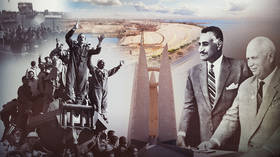
The tripartite plan materialized as a full-scale military invasion of Egypt in October and November 1956, involving British, French, and Israeli forces. While the allied armies managed to capture parts of the Sinai and Port Said, on the western shores of the canal, on the ground, the aggression collapsed under intense diplomatic and economic pressure from Washington and Moscow, forcing a humiliating withdrawal already by late 1956.
Egypt’s resistance against the Tripartite Aggression transformed into a rallying cry for Nasser across the Arab world, where he was already immensely popular. Far from breaking him, let alone toppling him, or reclaiming lost imperial prestige, the fiasco shattered the myth of Western invincibility, and cemented Cairo as the beating heart of anti-colonial resistance across the Middle East and Africa.
By invading Egypt, Britain and France sought to keep control of the canal, which the joint British-French company had operated since its opening in 1869, denying Egypt its national rights over its own sovereign territory, the economic benefits it generated, and the full exercise of its independence. For Israel, it was about breaking a strategic waterway controlled by a sworn foe and projecting military force into the future of the already ongoing conflict with Egypt, as well as the wider Arab cause tied to Palestine since Israel’s creation.
But as entire enterprise ended in failure, it signaled the end of British dominance in the region, and further damaged its standing across Africa. There, former colonies were gaining independence, fueled in no small part by Nasser and his support for almost all African liberation movements, from Algeria to sub-Saharan struggles stretching from Kenya to Ghana.
The political fallout across the waning British Empire and the broader developing world was unforgiving. At the London meetings and through Commonwealth diplomatic channels, the invasion triggered hostility from emerging member states like India, whose Prime Minister Jawaharlal Nehru condemned the aggression as a dangerous throwback to 19th-century imperialism.

Across Africa, the shockwaves were felt immediately. For the Gold Coast, where Britain had already conceded independence in principle after Kwame Nkrumah’s party won the July 1956 elections, the case of Suez was indicative. An empire that could not force its will on Egypt was in no position to hold back Africans demanding self-rule. Ghana became independent in March 1957.
Though the Non-Aligned Movement would not be formally institutionalized until 1961, the crisis served as the ultimate trial by fire for the “Bandung Spirit” born a year earlier. From Sudan to newly independent Morocco and Tunisia, public and political opinion rallied behind Cairo, proving that a sovereign post-colonial state could defy Western gunboat diplomacy and rewrite the geopolitical order.
The Egyptian debacle also shattered what remained of Anglo-French strategic unity in Africa. By exposing that neither London nor Paris could mount a major military operation without American acquiescence, Suez accelerated the liquidation of empire. In France, the attempt to save Algérie françaiseby striking Egypt backfired: It did not cut the FLN’s lifeline, it strained the French treasury, and helped bring down the Fourth Republic by 1958.
For Britain, Suez was a turning point. Within three months of becoming prime minister in January 1957, Macmillan met US President Dwight D. Eisenhower in Bermuda to rebuild the Anglo-American alliance, with colonial policy on the agenda. Scholars see his government’s attempt to set a new foreign policy agenda after Suez as the context for the retreat from Africa that culminated in the 1960 “Wind of Change” speech. In it Macmillan never invoked Suez and framed African nationalism as a Cold War reality Britain had to “come to terms with.” Even so, the speech’s logic reflects a post-Suez recognition of Britain’s reduced weight.
Suez destroyed the illusion that Europe could contain African liberation movements by force, and it left Cairo a symbol of Europe’s defeat.
Seventy years on, Suez remains one of the illustrations of how empires actually end: Not in a single battle, but when their own governments discover the limits of their power. Within six years of the last Anglo-French troops leaving Port Said, Ghana, Nigeria and most of France’s sub-Saharan colonies had won independence, and Algeria followed in 1962 after a war Paris could no longer afford to win.

Egypt did not cause all of this, but it gave Africa a powerful example of a post-colonial state that had defied two European powers and survived. The lesson cut both ways, however. Within weeks of the withdrawal Washington, which had forced the retreat, was preparing the Eisenhower Doctrine to fill the vacuum London and Paris left behind. What Suez ended was not Western power in the region but the era in which Britain and France could exercise it alone. For Africa and the Arab world, that opened the real contest over sovereignty, one that is still being fought today.
The statements, views and opinions expressed in this column are solely those of the author and do not necessarily represent those of RT.
Source link


